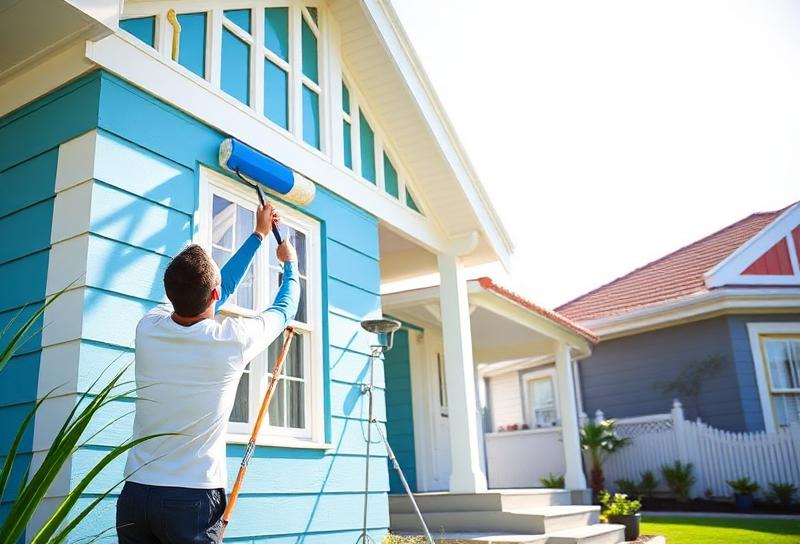

One of the most common questions we get from Brisbane homeowners is whether they need council approval to repaint their house. The short answer for most people is no — but there are real exceptions, and getting them wrong on a character or heritage property can be expensive.
Here is a practical explanation of how Brisbane City Council rules apply to painting. This is general guidance, not planning advice; always confirm your specific property's status with council before committing.
Start By Checking Your Property's Status
Every property in Brisbane sits under a set of planning overlays. Before you plan any exterior work, look up your address on the council's online property search and check for:
- **Traditional building character overlay** — applies to large parts of the inner and southern suburbs and covers pre-1947 housing
- **Heritage overlay** — a local heritage listing applied to individually significant places
- **Queensland Heritage Register entry** — a state-level listing, the strictest category
- **Demolition control precinct** — often overlapping with character areas
The overlay you fall under determines everything that follows.
Standard Properties: Repaint Freely
If your property carries none of the overlays above — which covers most homes in the newer northern, eastern and outer southern suburbs — you can repaint your house in any colour you like without approval. Painting is maintenance, not building work.
The only practical constraints are:
- Any body corporate or community title scheme by-laws, which frequently do control exterior colour
- Estate covenants on newer developments, which sometimes specify an approved palette
- Contractor licensing — any painting work valued above $3,300 must be carried out by a QBCC licensed contractor
Character Overlay Properties: Colour Is Usually Fine, Fabric Is Not
This is the category most people misunderstand. In a traditional building character overlay, council's concern is the built form and original fabric of the streetscape, not the paint colour itself.
**Generally does not require approval:**
- Repainting existing painted surfaces, including in a different colour
- Repainting trim, roofing and joinery
- Like-for-like replacement of a small number of damaged boards
- General maintenance and repair
**Generally does require approval:**
- Removing or replacing original weatherboards or VJ with a different material
- Removing fretwork, brackets, balustrades or other original detailing
- Enclosing or removing a verandah
- Cladding over original timber
- Painting a previously unpainted masonry or face brick surface — this is treated as an alteration of original fabric, and it is largely irreversible
That last point catches people out. Painting original face brick is one of the few colour-related actions that can genuinely be a problem, and it is worth confirming before proceeding.
Heritage-Listed Properties: Confirm Before You Start
If your property is on the local heritage register or the Queensland Heritage Register, the position is stricter. Colour schemes may be part of the listing, and works can require an exemption certificate or a development approval.
In practice this means:
- Contact council's heritage team, or the Department for state-listed places, before quoting begins
- Expect to justify the colour scheme with reference to period-appropriate palettes or paint scrape evidence
- Preparation methods may be constrained — abrasive blasting is generally not acceptable on heritage fabric
The upside is that council heritage officers are generally very helpful when engaged early. They are far less helpful after the work is done.
Rules That Apply Regardless of Overlay
Some obligations apply to every Brisbane painting job:
**Lead paint management.** Homes built before the late 1970s are likely to have lead-based paint. Removal must be managed under Queensland WHS requirements with containment, wet methods or HEPA extraction, and lawful disposal. This is not optional and it is not overlay-dependent.
**Stormwater protection.** Wash water, paint washout and debris must not enter the stormwater system. Contained washout is a legal requirement.
**Footpath and public space.** Any scaffold, hoarding, skip or work platform on council land needs a permit.
**QBCC licensing.** Work over $3,300 requires a licensed contractor, and your contract must be a QBCC-compliant written contract above the relevant thresholds.
**Waste disposal.** Paint tins, stripped material and lead-contaminated waste go to an appropriate facility, not a household bin.
Practical Steps Before You Repaint a Character Home
1. Look up your property on council's planning search and note every overlay.
2. If a character or heritage overlay applies, call council's planning information service and describe exactly what you intend to do.
3. Ask your painter to confirm in writing that they are QBCC licensed, insured, and will manage lead paint under a controlled process.
4. Choose a scheme from a heritage colour range if you are in a character street — it will suit the architecture and avoid any argument.
5. Keep records of what was done, including product names and colour codes, for future maintenance and for resale.
We Handle the Compliance
Tier 1 Painting works across Brisbane's character suburbs every week. We handle lead-safe processes, footpath permits and stormwater containment as standard, and we will tell you honestly if we think your project needs a council conversation before we start. See our heritage restoration service or book a free inspection.